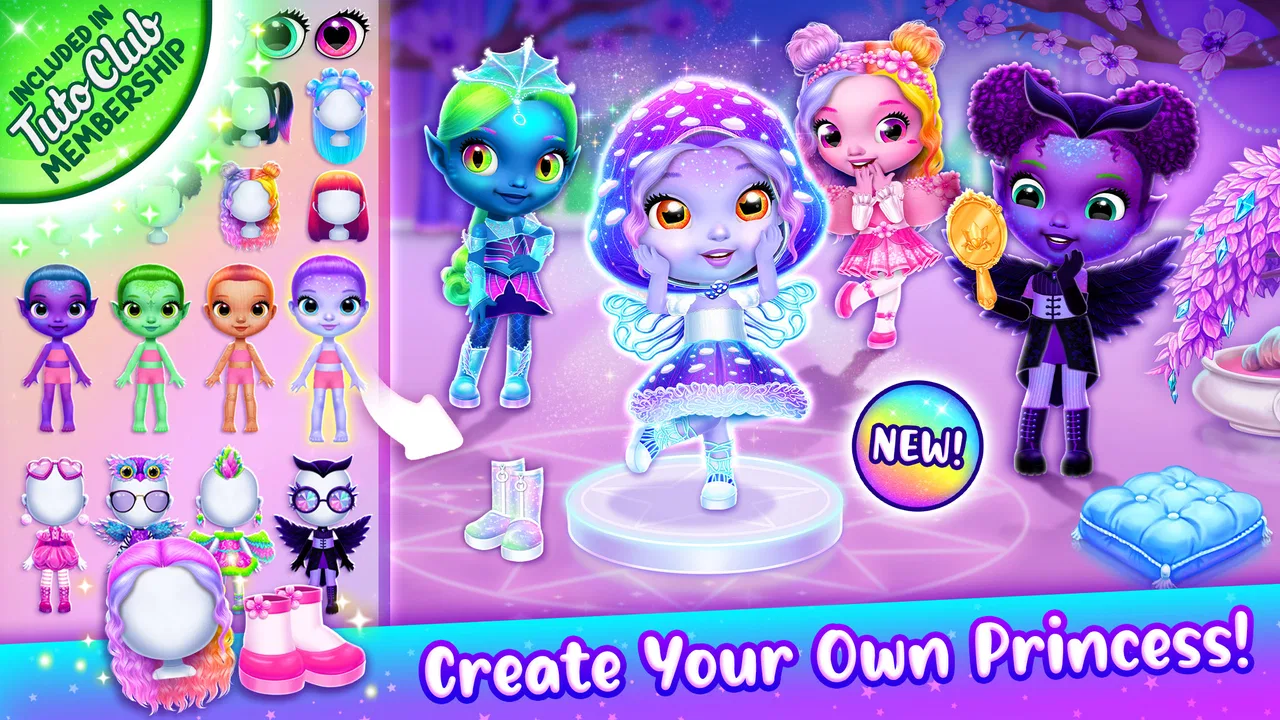
Princesses - Enchanted Castle
- 4.1
- Rating
- 10.00M
- Installs
- Free
- Price

 Analysis by App-foxy
I spent time with Princesses - Enchanted Castle as a light, child-friendly game, and my first impression was clear: this is aimed at imaginative play rather than challenge-heavy gaming. The idea is simple to understand. You look after cute princess characters, explore a magical setting and turn small moments into pretend-play stories. It feels closer to a digital dollhouse than to a traditional level-based adventure.
That distinction matters before downloading it. If you want fast competition, difficult puzzles or a long campaign with demanding goals, this probably will not be your best match. If you are looking for a gentle educational game for children that encourages choosing, arranging and caring for characters, its approach makes much more sense. I found it easiest to enjoy when I stopped expecting a conventional win-or-lose structure and treated the castle as a place for open-ended play.
How the enchanted castle feels in everyday use
The game comes from TutoTOONS and is listed as a free title for everyone, with a child-oriented presentation that is easy to approach. Its store summary presents a magical girl game built around dreams, collecting and caring for princesses, but the useful point for a parent is how accessible that concept is. A child does not need a complicated explanation to understand the basic appeal: there are princesses, a castle and opportunities to make the setting feel personal.
You May Also Like

 Blood Strike: 2.5 Anniversary
Blood Strike’s Loadouts Turn Every Drop Into a Tactical Gamble
A close look at Blood Strike’s custom loadouts: how fast access to signature weapons reshapes its battle royale rhythm, rewards preparation, and narrows the gap between fights.

 Pandora - Music & Podcasts
Pandora’s Music Is Easy to Start, but Harder to Recover
Pandora’s strength is its low-effort path from a seed to a station. Its weak spot is how much confidence it asks you to place in connection, setup, and quiet recovery.

 8 Ball Pool
 Is Built on Rivalries, Rematches, and Routine
A close look at the rivalries, rematches, shared routines, and unanswered safety questions that turn a quick pool match into a persistent mobile community.

 Samsung Music
’s Quiet Strength Is Playing What You Already Own
Its reach comes less from spectacle than from dependable access to a personal library. That simplicity is both the app’s strongest retention engine and its ceiling.

 AccuWeather: Weather Radar
AccuWeather Review: A Quick, Clear Forecast for Everyday Decisions
For everyday plans, the best forecast is the one you can understand quickly. AccuWeather makes rain timing, radar, and local conditions easy to act on, with a few trade-offs.

 Hill Climb Racing
Why Hill Climb Racing Still Turns Crashes Into One More Run
A tiny car, a bumpy hill and one more upgrade: Hill Climb Racing keeps resurfacing because its simple chaos makes every near-miss feel personal.
More From Our News Desk



In my experience, this kind of design works best in short, relaxed sessions. A child can open the game after school, spend a little time interacting with the characters and then put it away without needing to remember a complicated mission chain. That makes it more suitable for casual play than for a family expecting a structured lesson plan. The educational value is informal: decision-making, visual attention, simple sequencing and imaginative storytelling are encouraged through play rather than presented as exercises.
One realistic use case is a quiet waiting period. A child sitting beside a parent at an appointment may enjoy creating a small princess scenario, changing the focus of the play and then stopping naturally. I would not use it as a replacement for reading, creative activities away from a screen or direct learning with an adult, but it can fill a short gap without demanding the intensity of an action game.
The strongest part of the experience is its softness. The castle theme gives children a familiar framework, while the princess characters provide a reason to return and invent new situations. Instead of asking the player to master timing or defeat opponents, it invites them to care, arrange and imagine. That can be especially appealing to children who become frustrated by failure screens or games that constantly push them toward the next objective.
There is also a trade-off. Open-ended play can feel liberating to one child and aimless to another. A child who needs clear instructions may quickly ask what to do next. I found that the game benefits from a little adult involvement at the beginning: asking the child which princess they are caring for, what is happening in the castle or why they chose a particular action can turn a short session into a more active storytelling exercise.
What makes it different from ordinary children’s games
Compared with a conventional educational game built around spelling, counting or quizzes, this title is much less about checking correct answers. It uses the fantasy setting as its main teaching environment. That makes it a better fit for imaginative and social play than for a parent who wants visible academic progress after every session.
Compared with a standard dress-up app, the castle theme gives the experience more context. The princesses are not merely presented as static characters to customize; the caring angle encourages the child to think about what a character might need and how a scene should unfold. I would still describe the experience as play-first, though, not as a deep simulation. Anyone expecting detailed management systems or a complex story may find it intentionally simple.
It also differs from competitive mobile games because there is no need to compare performance with another player. That lowers pressure and makes it easier for siblings or parents to participate verbally. A useful approach is to let the child lead the story while the adult asks open questions instead of taking control. This turns the game into a prompt for conversation rather than a passive distraction.
What I noticed about the current version
The current version is 2.11.119, and the game was released on April 26, 2023. Those details place it in an established stage rather than at the very beginning of its life. I would approach the present release as the version to judge today, while avoiding assumptions that every future update will change the experience in a particular way.
For someone already playing, the practical lesson is to judge an update by how smoothly the existing castle routine continues. In a game built around familiar characters and repeated care activities, small changes can affect comfort more than they would in a one-time puzzle. If a child has already created favourite stories, preserving that sense of familiarity is more important than adding complexity for its own sake.
I would also avoid treating the version number as proof of a particular feature set. A later version can indicate ongoing maintenance, but it does not automatically mean the game has become deeper, more educational or more suitable for older children. My view is that the current release should be evaluated for its calm, accessible style, not for expectations of a major transformation.
The public reception gives the game a mixed but substantial footprint: it has an average rating of 3.9 from around 23 thousand ratings, with about 530 written reviews and more than 10 million installs. I read that as evidence that the concept reaches a large audience while still leaving room for individual preferences. A child who loves princess role-play may find it charming, whereas a child looking for constant novelty may be less impressed.
Those figures are useful context, but they should not replace a family’s own test. Children respond very differently to the same visual style and pace. I would watch whether the child returns to the characters voluntarily, whether they invent stories without prompting and whether the play remains comfortable rather than becoming a request for purchases. Those observations tell you more than popularity alone.
How the free model changes the decision
The game is free to download, but it includes in-app purchases ranging from $1.99 to $119.99 per item. For me, that is one of the most important practical points for families. A free starting point can make it easy to try the basic experience, but the presence of optional purchases means an adult should handle the download and review the device’s purchase protections before handing it to a child.
I would establish a simple rule before the first session: the child can play with what is available, but any purchase requires an adult’s permission. That conversation is more useful than presenting the game as completely free. It also helps a child understand that a tempting item is not automatically part of the play session.
Another good habit is to play the first few sessions together. This lets you see whether the child can enjoy the castle without feeling pushed toward extra content. It also reveals whether the game’s free portion is enough for your household. If the child is satisfied with the available activities, there may be no reason to spend anything. If the experience quickly becomes frustrating without paid additions, that is a meaningful warning that the game may not suit your family’s expectations.
I would not describe the purchase range as a minor detail, even though the game itself is free to start. It changes the way I recommend it. I am comfortable suggesting a supervised trial, but I would not give a young child unrestricted access to the device’s payment process. That is not a criticism of the fantasy concept; it is simply part of making a child-focused mobile game fit responsibly into everyday use.
Who will enjoy it, and who should skip it
I think the best audience is children who enjoy princess stories, caring for characters and making up scenes. It is also a reasonable choice for parents who want a gentle game that can support conversation and pretend play. The Everyone rating makes the intended audience broad, but the actual appeal still depends on personality. A child can be within the age rating and still find the pace too quiet or the theme uninteresting.
I would recommend trying it first for a child who likes arranging imaginary worlds rather than chasing high scores. It may work well as a shared activity where an adult asks the child to explain what is happening in the castle. That small change makes the game more interactive and gives the child a chance to practise describing choices and events.
I would skip it if your main goal is measurable school practice. The game should not be confused with a dedicated reading tutor, maths trainer or language-learning course. Its educational category reflects a child-friendly learning-through-play direction, but I would not use it to replace a purpose-built app when a specific academic skill is the priority.
I would also look elsewhere for an older child who wants strategic depth, difficult objectives or a substantial adventure narrative. The princess-and-castle format is welcoming, but that same simplicity can feel limited once a player wants more challenge. In that situation, a puzzle game, story adventure or construction game may offer better long-term engagement.
Small strategies that improve the experience
My first practical tip is to give each session a tiny story goal. Instead of opening the game with no direction, suggest a scenario such as preparing the castle for a celebration or helping one princess through a busy day. The child still controls the play, but the prompt reduces the feeling of wandering and encourages language, sequencing and creative decisions.
Second, rotate the child’s role. One session can focus on caring for a character, while another can focus on describing the castle as if it were a setting in a story. This prevents the game from becoming a repetitive tap-through routine. It also makes the same content useful for different kinds of play, especially when an adult joins for a few minutes.
Third, use the game as a stopping point rather than an endless background activity. Ask the child to finish the current story, explain what happened and then close the app. That gives the session a natural ending and helps separate imaginative play from continuous screen time. I found this approach more satisfying than leaving the game open while attention gradually fades.
A fourth consideration is shared-device use. If siblings play on the same device, agree on turns and let each child create their own story rather than competing over the same actions. The game’s non-competitive style can support cooperation, but only if the adults avoid turning access into a race. Taking turns also makes it easier to notice which parts each child actually enjoys.
Where the experience still falls short
The main limitation is that the gentle design can lack urgency. Without a clear challenge, some children may enjoy the novelty once and then move on. That is not necessarily a flaw for a short-session game, but it does affect value for families hoping for a single app that remains engaging for months.
The second limitation is the gap between fantasy appeal and educational depth. The game can encourage imagination and simple decision-making, but parents should not expect detailed instruction simply because it sits in an educational category. I would pair it with books, drawing, conversation or hands-on activities if the goal is broader development.
The purchase system is another point where adult supervision matters. A child may understand the play immediately but not understand the real-world cost attached to an optional item. I would treat purchase controls as part of setup, not as something to think about after a problem occurs.
There is also a personal taste issue. Princess themes are central rather than incidental, so a child who prefers vehicles, animals, science or building may not connect with the game even if they enjoy mobile play generally. Choosing it because it is popular would be less sensible than watching for a genuine interest in the setting.
What I would watch as the game continues
For future development, I would pay attention to whether the game keeps its approachable style while giving returning players more meaningful reasons to revisit the castle. New material can be helpful, but it should not make the experience more confusing for younger players or turn the caring theme into a pressure to buy.
I would also watch how well the game serves both sides of its audience: children who want free-form stories and parents who want play to feel worthwhile. The best direction would preserve the easy entry point while offering gentle ways to extend a story, make choices more thoughtful or involve an adult without requiring constant supervision.
Existing users should judge changes by the effect on their child’s routine. If an update keeps favourite characters and familiar play comfortable, that is valuable even if the visible additions seem modest. New users, meanwhile, should focus on the current experience rather than waiting for promised possibilities. The game already has a clear identity, and that identity is more important than speculation about what might arrive later.
After using it, I see Princesses - Enchanted Castle as a pleasant, accessible choice for children who enjoy magical role-play. Its strengths are the welcoming theme, the low-pressure style and the opportunity to turn simple interactions into stories. Its weaknesses are equally clear: limited challenge for older players, informal rather than academic learning and a free-to-play purchase model that needs adult attention.
My recommendation is to try it as a supervised creative-play app, not as a complete educational curriculum. If your child likes princesses and enjoys caring for characters, the castle can provide a calm space for imagination. If you need rigorous lessons, deep progression or a game that stays exciting through challenge alone, I would choose a different category. For the right child, though, this free game offers an easy starting point and enough fantasy structure to make short everyday sessions feel purposeful.
FAQs for Princesses - Enchanted Castle
01What is the main gameplay of Princesses - Enchanted Castle?
Princesses - Enchanted Castle is a fantasy adventure game where players explore a magical castle filled with puzzles, hidden objects, and interactive stories. Players can customize their princess character, make choices that affect the storyline, and engage in various mini-games to uncover the mysteries of the enchanted castle.
02Is Princesses - Enchanted Castle suitable for children?
Yes, Princesses - Enchanted Castle is designed to be family-friendly and suitable for children. It features colorful graphics, simple controls, and engaging stories that encourage creativity and problem-solving. Parents can feel confident that the content is appropriate, and it can be a great way for kids to enjoy interactive storytelling.
03Are there in-app purchases in Princesses - Enchanted Castle?
The game offers optional in-app purchases to enhance the gaming experience. Players can buy gems or special items to unlock premium content, such as exclusive outfits or faster progression. While the game is free to download, these purchases are not required to enjoy the full game, but they can provide additional customization and convenience.
04What platforms is Princesses - Enchanted Castle available on?
Princesses - Enchanted Castle is available on both Android and iOS platforms. Players can download it from the Google Play Store or the Apple App Store. The game is optimized for smartphones and tablets, ensuring smooth gameplay and an immersive experience across various devices.
05Does Princesses - Enchanted Castle require an internet connection?
While an internet connection is not required for core gameplay, having one can enhance the experience. Online features include accessing updates, participating in events, and syncing progress across devices. If you wish to make in-app purchases or connect with friends, an internet connection will be necessary.
Pros
- Engaging storyline captivates users.
- Rich graphics enhance visual appeal.
- Customizable characters add depth.
- Regular updates with new features.
- Intuitive controls for easy gameplay.
Cons
- In-app purchases can be pricey.
- Occasional bugs disrupt experience.
- Long loading times frustrate users.
- Requires constant internet connection.
- Limited offline gameplay options.

Princesses - Enchanted Castle
Gallery